


Towven.com – It is a warm morning. You stand in front of your closet, half awake, and pull on a shirt, then a pair of pants. Maybe a jacket, even though you won’t need it. You don’t think about it. Getting dressed feels as automatic as breathing.
But the story you learned in school is probably backwards. It goes like this: ancient humans were cold, so they wrapped themselves in animal skins, and clothing was invented to keep us warm. End of story.
The evidence doesn’t agree. The real answer to why did humans start wearing clothes may be far stranger than warmth, and it starts with a tiny insect.
Our Ancestors Didn’t Need a Coat
Go back far enough and your ancestors were covered in thick body hair, much like the great apes today. Then, somewhere between one and two million years ago, they began losing most of it. Scientists still debate exactly why. The leading idea is that it helped them stay cool. Humans were becoming long-distance walkers and runners under a blazing African sun, and a nearly bare body covered in sweat glands is one of the best cooling systems in the animal kingdom.
That means your ancestors lived for well over a million years with almost no fur, in a warm climate, and did just fine. They did not need a coat. So why would they suddenly invent one?
The Louse That Rewrote the History of Human Clothing
Humans carry three kinds of lice: head lice, pubic lice, and body lice. Two of them live happily on bare skin and hair. Body lice are different. They live in your clothes, clinging to the fabric and visiting your body only to feed.
That makes them a remarkable clue. Body lice could not exist until clothing existed, so their DNA works like a clock. Researchers can estimate when body lice split from head lice, and that reveals roughly when clothing began. It is a molecular fossil written into the genes of a parasite that has ridden along with our species for ages.
This body lice clothing origin research surprised almost everyone. The studies point to a split around 100,000 years ago, with some estimates reaching back 170,000 years. The exact figure is debated, but the message is clear. When you ask when did humans start wearing clothes, the answer is far earlier than most people imagine.
And that is where the old story breaks. A hundred thousand years ago, most of our ancestors were still in Africa. Days were hot, though nights could turn cold, and the deep ice age freeze was still far to the north. Warmth may have helped, but it cannot explain why clothing appeared long before humans ever faced the true cold.
So what if clothing did not begin as protection at all?
Red Paint: The First Message
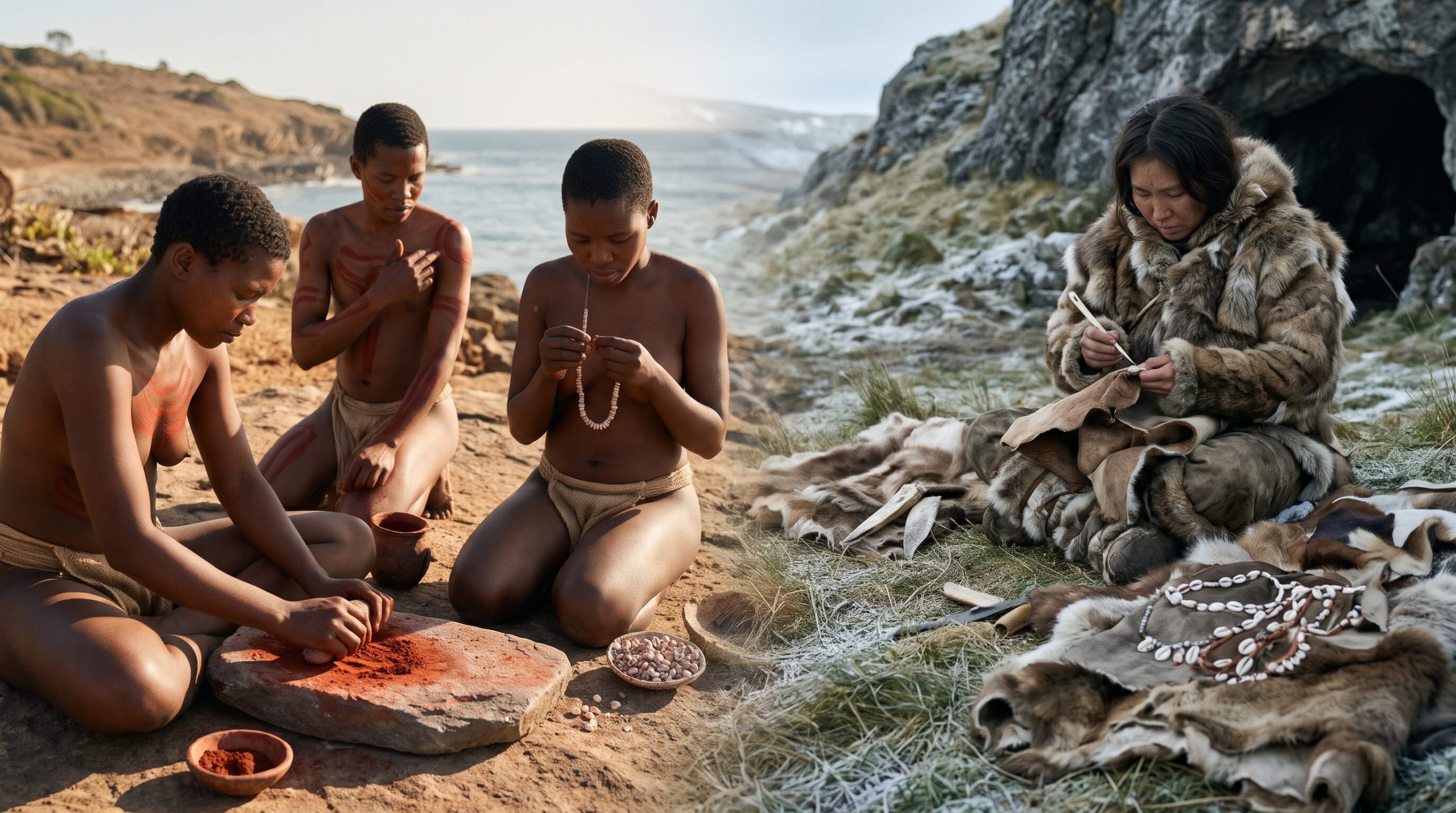
To understand the origin of clothing, you have to meet a material that looks nothing like fabric: ochre. It is a soft, rusty red stone rich in iron. Crushed, it becomes a vivid red powder, almost like natural paint.
Archaeologists have found ochre at sites hundreds of thousands of years old. It was ground up, mixed with other materials, and carried around, clearly prepared on purpose. Your ancestors weren’t stumbling across pretty rocks. They were making color.
And what do you do with red paint if you have a bare body and no mirror? You paint yourself. Ancient body paint ochre may be one of the oldest forms of human decoration: stripes, patterns, handprints, colors that said something about who you were. Not a coat. A message.
The Oldest Shell Beads Jewelry Ever Found
Then, around 75,000 years ago, a new kind of object appears. At a cave in South Africa, researchers found small seashells with tiny holes drilled through them. Strung together, they would have made a necklace. Even older shell beads have been found in North Africa, dating back more than 140,000 years. These are among the oldest shell beads jewelry on record.
Pause on that. Your ancestors were crossing landscapes, trading shells, drilling holes by hand, and threading them into jewelry tens of thousands of years before farming, writing, or cities. Shells don’t keep you warm. They don’t feed you or help you hunt. They tell the people around you who you are.
Identity First, Warmth Second
Here is how many researchers think the story unfolded. Imagine living in a small band of about thirty people. Every face is familiar. Then bands begin meeting other bands, trading, sharing water, and forming alliances.
Suddenly you are surrounded by strangers, and you have a very old, very urgent problem: who is a friend, and who is not?
You can’t ask everyone for their life story. You need a faster signal, something visible from a distance. Body paint could do that. Beads could do that. Wrapped skins, decorated and marked, could do it even better.
This is one possible answer to why did humans start wearing clothes: identity first, not warmth first. In the old version, clothing is a shield against the world. In this version, clothing is a language that speaks before anyone says a word.
The truth is more layered than a single reason, though. Once our ancestors started wrapping their bodies, they would have noticed other benefits:
- Skins protected bare legs from thorns and biting insects.
- Wraps shielded skin from burning sun.
- Belts and pouches let them carry tools, stones, and food with their hands free. A strip of hide around the waist was a portable pocket.
Warmth did matter, eventually. It just may not have been the spark.
When the World Turned Cold
Around 50,000 years ago, modern humans spread out of Africa into colder lands: Europe, Northern Asia, places where winter could kill you in a single night. Here, clothing stopped being optional.
In a cave in Siberia, archaeologists found a bone needle with a tiny eye for thread, about 50,000 years old and among the oldest known needles in the world.
Later sites hold hundreds of them. A needle means stitching, tailored sleeves, layers, and sealed seams. The same species that once painted their skin red was now sewing fitted winter clothes from fox fur and reindeer hide.
Neanderthals lived in the same cold world and almost certainly used animal skins too, but the clearest evidence of fine sewing with eyed needles appears among modern humans. The details are still debated, but the pattern is striking.
In the prehistoric clothing history told by the evidence, clothing for show came first, and clothing for survival grew from it.
Your ancestors did not invent clothes to survive the cold. They invented clothes to belong, to stand out, to signal, and to connect. Then, when the world turned freezing, they discovered that the thing they had already created could also keep them alive. This is the part of the history of human clothing that the old story leaves out, and it reshapes how we think about ancient humans clothing as a whole.
Why Humans Wear Clothes: The Psychology Still Running Inside You
This is also early human behavior explained in a way you can feel today. Think about how you choose what to wear. Do you check the temperature first? Sometimes. But other questions quietly shape your choice. What will people think? Does this look professional? Does this match the group I’m joining today?
You wear a uniform to work, a team jersey on game day, a black outfit to a funeral, a particular style that signals which music you love or which crowd you run with. Every one of those choices is the same ancient behavior. You are painting yourself for the tribe.
That is the heart of why humans wear clothes psychology. Walk into a formal event in casual clothes and your stomach tightens. Walk into a casual party in a suit and you feel the same twist. That feeling isn’t vanity. It is a very old alarm, built to warn you that you might be reading as an outsider.
It also explains why clothing feels so personal. It’s why someone mocking your appearance can sting more than it seems like it should, and why a new outfit can change how you stand, how you speak, even how you feel about yourself.
Your closet is a time capsule, and every belt, necklace, watch, and logo descends from those drilled shells and red ochre handprints.
You Are Speaking the Oldest Language
You are not just covering your body. You are telling a story about who you are, and you have been telling it for more than a hundred thousand years.
So the next time you stand in front of your closet on a warm morning and reach for something you don’t need for warmth, notice that quiet pull.
It is not random, and it is not shallow. It is the voice of an ancestor on an African shore, holding up a tiny shell and wondering how to say who they are without saying a word.
You thought you were just getting dressed. But you were speaking the oldest language your species ever invented.
And you still are.