
If all humans share 99.9% of the same DNA, why can a life-saving blood transfusion for one person be fatal to another?
When Austrian physician Karl Landsteiner discovered the ABO blood group system in 1900, he solved the mystery of why blood transfusions so often failed. Yet his discovery raised an even deeper evolutionary question: why didn’t natural selection simply give everyone the same universal blood type?
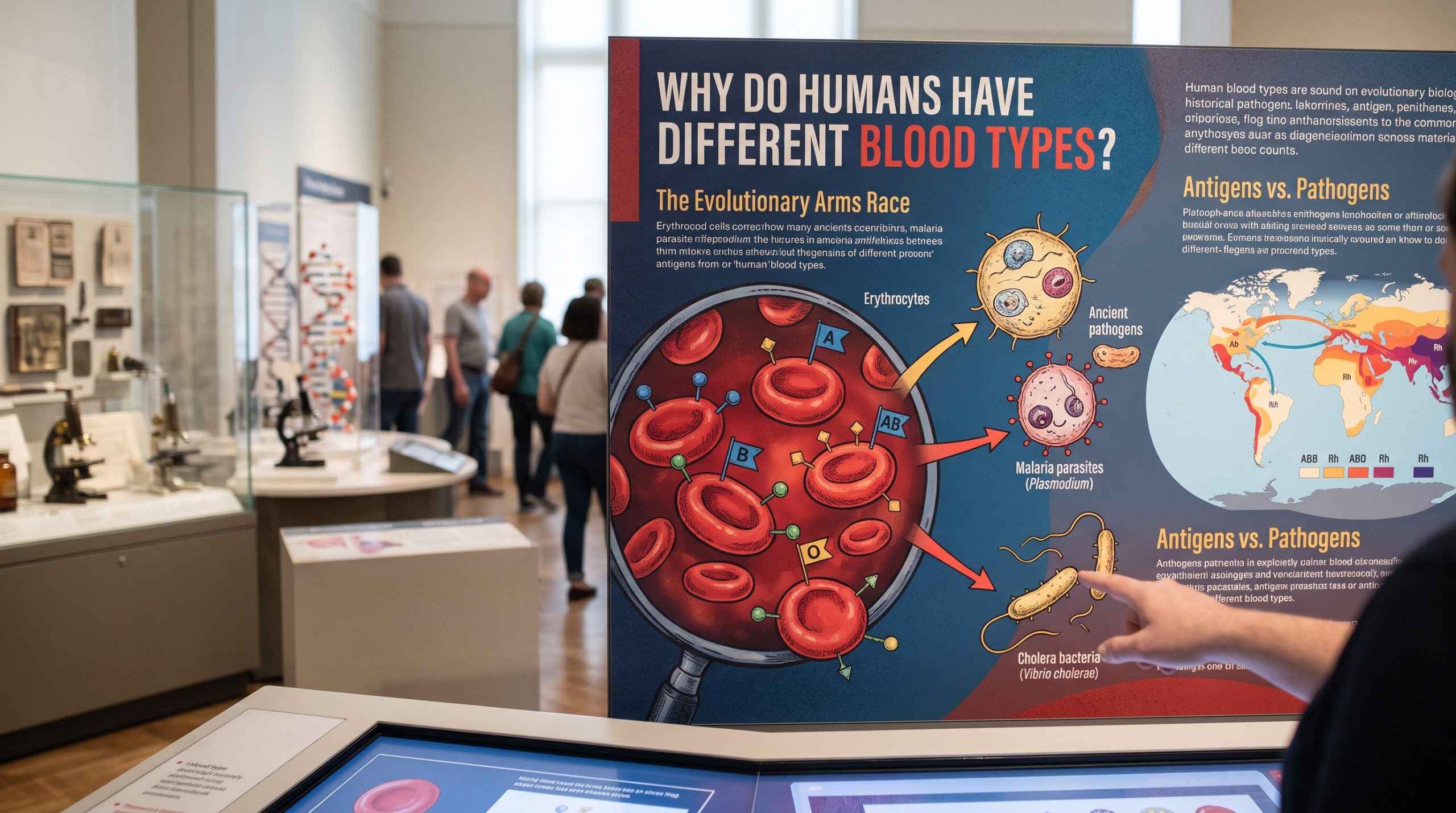
To understand why blood types exist, we first have to look at the microscopic surface of our red blood cells. Blood types are determined by antigens specialized sugars and proteins extending from the cell membrane like microscopic identification flags.
-
Type A blood carries the A antigen.
-
Type B blood carries the B antigen.
-
Type AB carries both A and B antigens.
-
Type O lacks both A and B antigens entirely.
Alongside the ABO system sits the Rh factor, a separate protein antigen. If your red blood cells have it, your blood is positive; if they don’t, it is negative.
Your immune system patrols your bloodstream using antibodies, which treat any foreign antigen like an invading virus. Give Type B blood to a Type A patient, and their anti-B antibodies will attack the donor cells, causing fatal clotting.
From a purely medical standpoint, having different blood types seems like an evolutionary flaw.
However, evolution isn’t driven by modern medicine it is driven by infectious disease. Scientists believe blood types evolved at least 20 million years ago in a common ancestor of humans and other great apes, preserved over millennia through a mechanism called balancing selection.
Infectious microbes viruses, bacteria, and parasites often use blood antigens as docking stations to invade cells, or mimic them to hide from our immune system.
If every human shared a single blood type, a single mutated pathogen optimized for that specific antigen could wipe out the entire species. By maintaining diverse blood types within a population, humanity built a biological firewall.
Perhaps the clearest example of this evolutionary arms race is malaria. Plasmodium falciparum, the deadliest malaria parasite, causes infected red blood cells to stick to blood vessel walls, leading to fatal blockages.
This sticking process relies heavily on the A antigen. Because Type O blood lacks this antigen, people with Type O are significantly less likely to die from severe malaria. Consequently, in regions where malaria has historically been rampant such as sub-Saharan Africa Type O is overwhelmingly the most common blood type.
Conversely, Type O carries its own vulnerabilities. The bacteria responsible for cholera (Vibrio cholerae) triggers much more severe, life-threatening dehydration in people with Type O blood than in those with Type A or B.
In regions where cholera has been an ancient scourge, such as the Ganges Delta in South Asia, the frequency of Type O drops sharply while Type B surges. Similarly, certain strains of norovirus latch onto the specific sugars of Type A or O blood, leaving Type B individuals naturally resistant.
Ultimately, our blood types are living fossils of the plagues our ancestors survived. The map of human blood groups across the globe is a map of ancient epidemics proof that in the relentless war against disease, genetic diversity is humanity’s greatest shield.
Comments are for Silver members and up
Join the community to share your thoughts. Members keep the discussion friendly and spam-free.