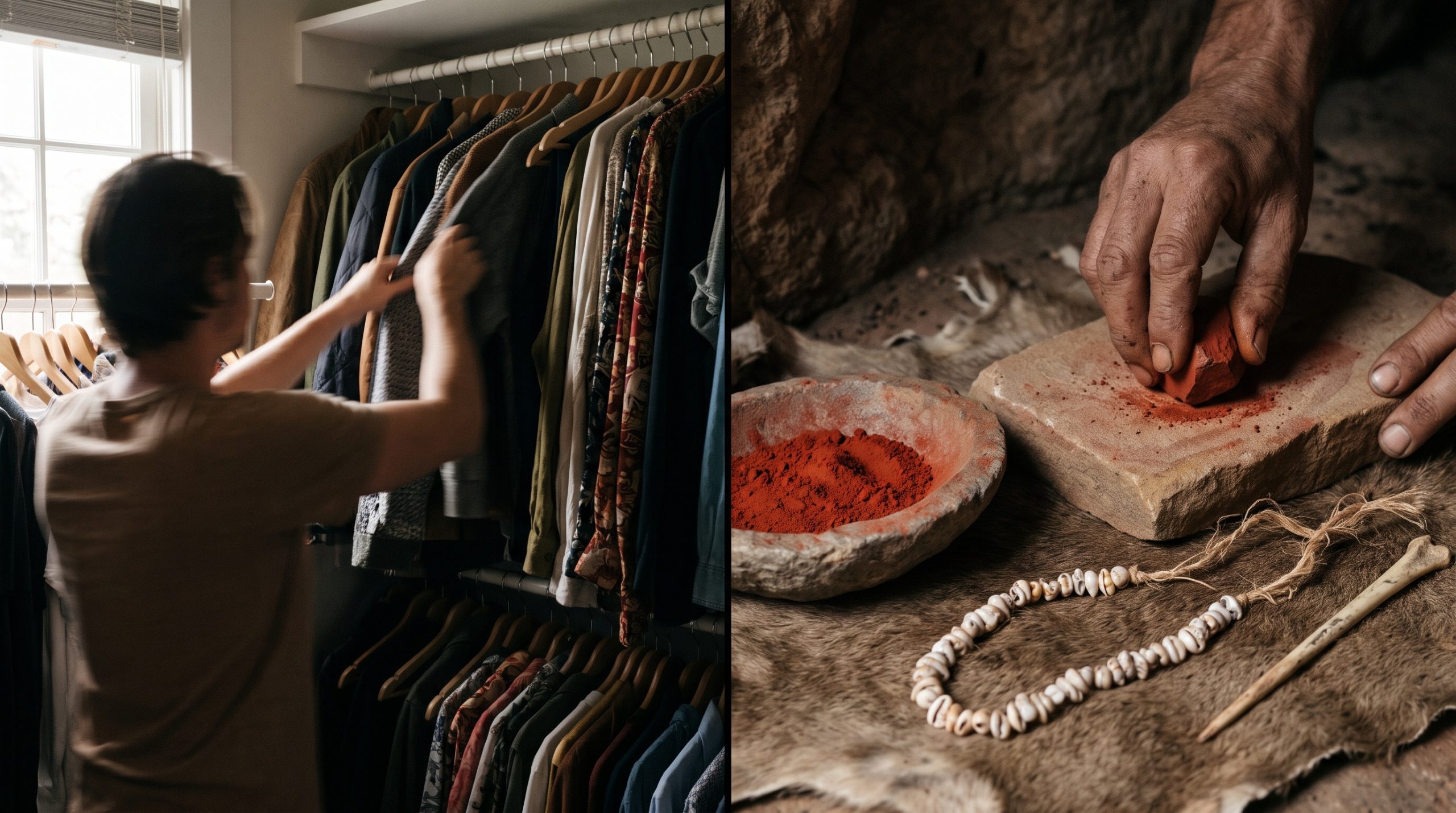





Towven.com – It is a warm morning. You stand in front of your closet, half awake, and reach for a shirt, a pair of pants, maybe a jacket you won’t need. You don’t think about it. Getting dressed feels as automatic as breathing.
Ask most people why did humans start wearing clothes, and you will hear the same answer: to stay warm. It sounds obvious. But the earliest clues don’t look like coats at all. They look like red powder and tiny seashells.
The Clue That Doesn’t Look Like Clothing
Animal skins rot. Cloth falls apart. After tens of thousands of years, almost nothing survives, which is why the origin of clothing is so hard to study. Archaeologists can’t dig up a 100,000-year-old shirt.
What survives are stones, shells, bones, and pigment. And those leftovers tell a surprising story about what our ancestors cared about, long before the coldest stretches of the ice age.
First, a Rough Date
Before the paint and shells, it helps to know roughly when did humans start wearing clothes. One of the best clues comes from an unlikely witness: the body louse. Unlike head lice, body lice live in clothing, clinging to fabric and visiting your body only to feed. They could not exist until clothing did.
By comparing lice DNA, researchers can estimate when body lice split from head lice. The studies point to around 100,000 years ago, and some estimates reach back as far as 170,000 years.
Those are estimates, and scientists argue about the exact number. But they suggest clothing is far older than most people imagine, and that fits the prehistoric clothing history told by the objects below.
Red Ochre: Humanity’s First Paint
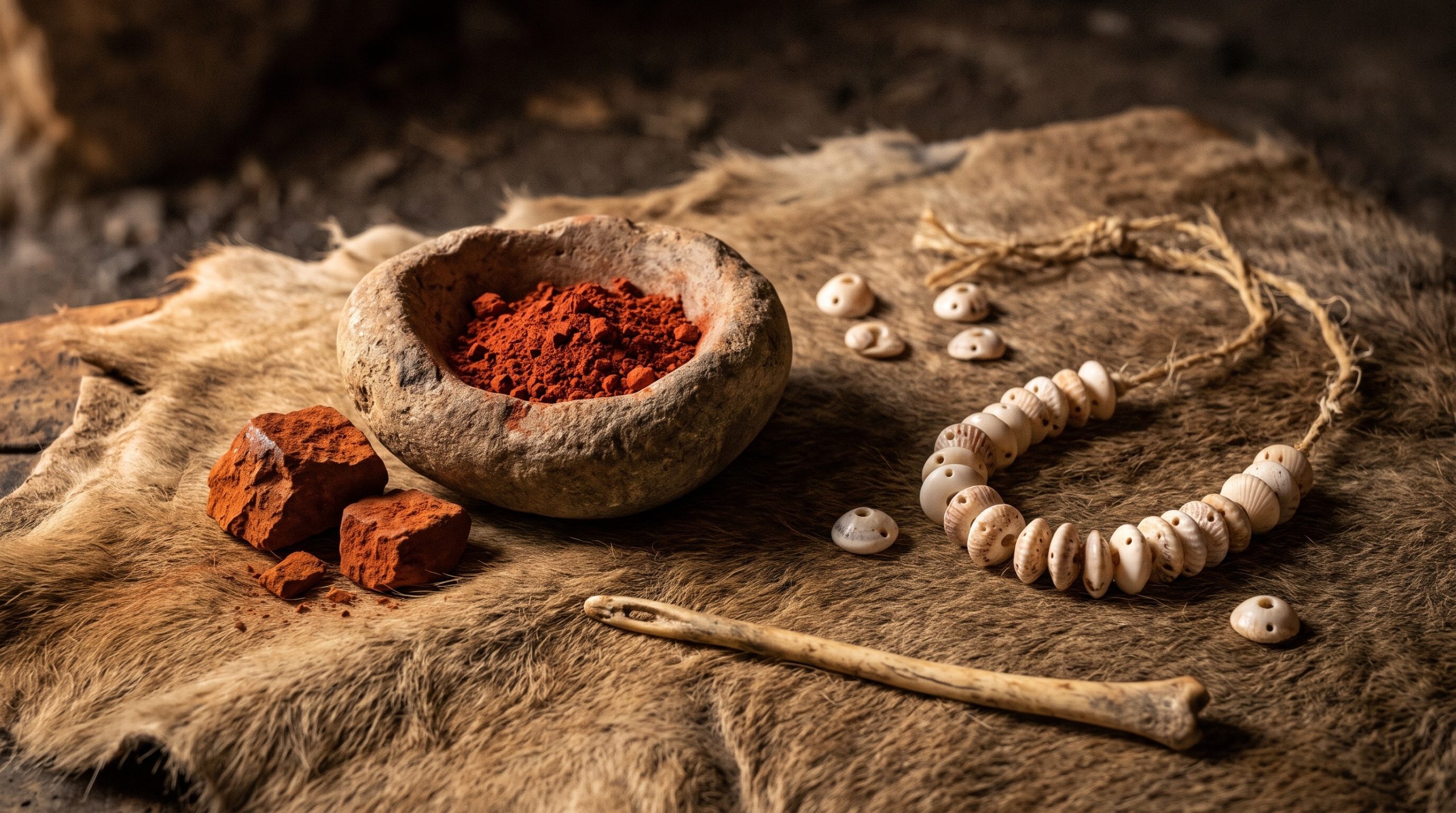
Now to the red powder. Ochre is a soft, rusty stone rich in iron. Crushed and ground, it becomes a vivid red pigment, and the red ochre pigment history goes back hundreds of thousands of years.
Archaeologists have found ochre at ancient sites across Africa, ground up, mixed with other materials, and carried around on purpose. Your ancestors weren’t stumbling across pretty rocks. They were making color.
What did they do with it? We can’t be certain. Ochre may have been used to treat hides, to protect skin from sun and insects, or to decorate tools.
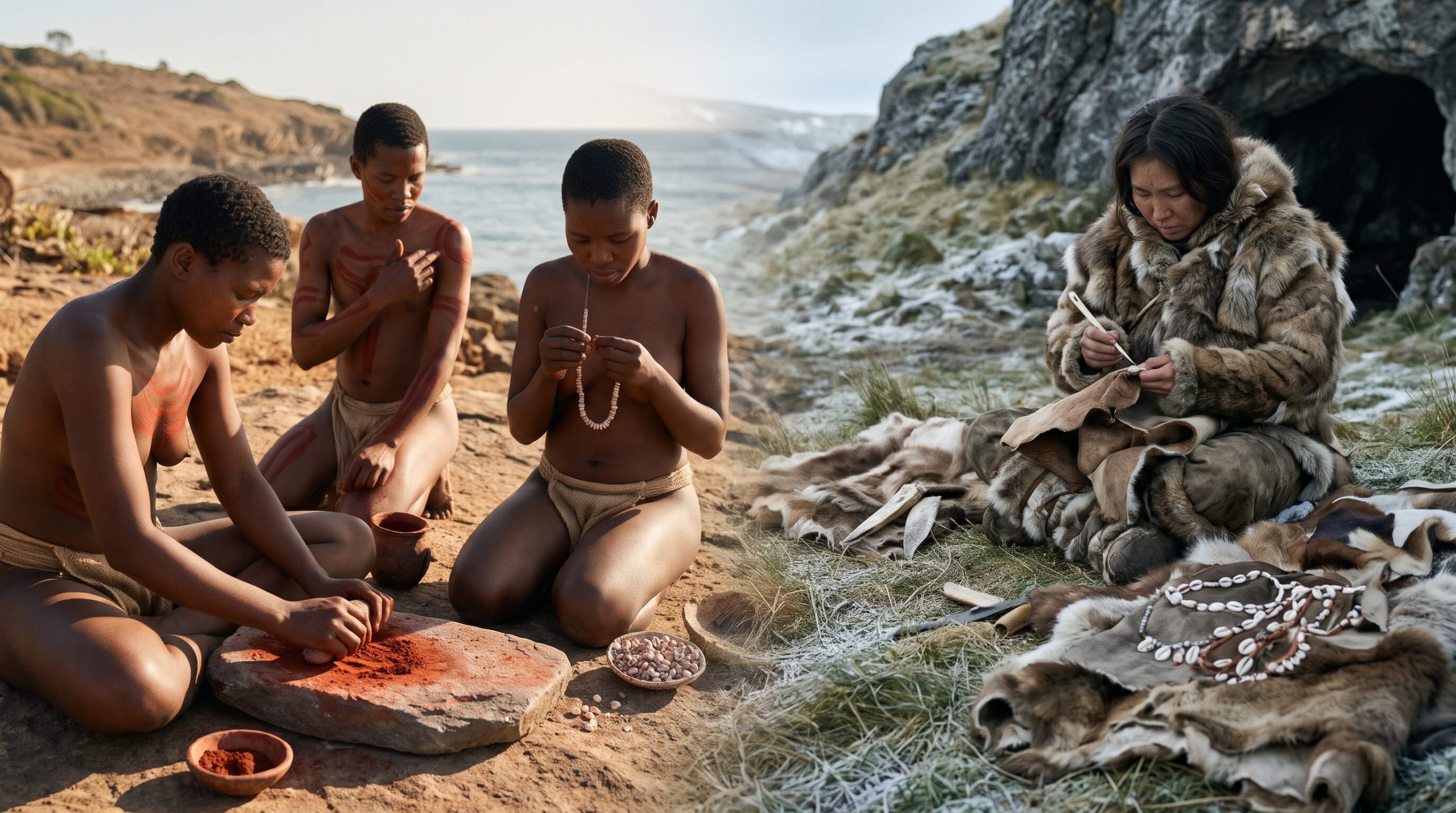
But many researchers think ancient body paint ochre was among the first forms of human decoration: stripes, patterns, handprints, colors that said something about who you were. Not a coat. A message.
Shell Beads: The Oldest Jewelry
Around 75,000 years ago, small seashells with tiny holes drilled through them appear in a cave in South Africa.
Strung on a cord, they would have made a necklace. Even older shell beads have been found in North Africa, dating back more than 140,000 years. These are among the oldest shell beads jewelry ever discovered.
Pause on that. Your ancestors were trading shells, drilling holes by hand, and threading them into jewelry tens of thousands of years before farming, writing, or cities. Shells don’t keep you warm. They don’t feed you or help you hunt. They tell the people around you who you are.
Why Paint and Beads Matter
Archaeologists call this early human symbolic behavior: using objects to stand for ideas, such as belonging, status, or identity. Body paint and beads are some of the earliest known examples. Your ancestors weren’t just surviving. They were communicating.
Here is how many researchers think this could connect to clothing. Imagine a small band of about thirty people. Every face is familiar.
Then bands begin meeting other bands, trading, sharing water, and forming alliances. Suddenly you are surrounded by strangers, and you have a very old problem: who belongs with you, and who doesn’t?
You can’t ask everyone for their life story. You need a faster signal, something visible from a distance. Paint could do that. Beads could do that. Decorated skins could do it too. This is the idea of clothing as identity: before it was only protection, it may also have been a language.
Warmth Still Mattered
None of this means warmth was irrelevant. Some of the older lice estimates fall during a long, cold, dry glacial period, and chilly nights may well have given early humans a practical reason to drape themselves in skins. Hides likely solved real problems, from cold nights to thorns, sun, and biting insects.
A strip of leather could also work as a belt or pouch, leaving hands free to carry tools and food.
So the honest answer is layered. Warmth, protection, and decoration probably developed side by side, each reinforcing the other. What the paint and beads suggest is that warmth may not have been the only reason, or even the first.
When the World Turned Freezing
Around 50,000 years ago, modern humans spread out of Africa into Europe and Northern Asia, where winter could kill you in a single night. Here, clothing stopped being optional.
In a cave in Siberia, archaeologists found a bone needle with a tiny eye for thread, about 50,000 years old and among the oldest known needles in the world. Later sites hold hundreds of them.
A needle means stitching, tailored sleeves, layers, and sealed seams. The same species that painted its skin red was now sewing fitted winter clothes from fox fur and reindeer hide.
Neanderthals lived in the same cold world and almost certainly used animal skins too, but the clearest evidence of fine sewing appears among modern humans. The details are still debated, but the overall history of human clothing looks like this: decoration and protection grew up together, and the deep cold made fitted clothing essential.
The Oldest Habit You Still Have
This is also why your closet feels personal. On a warm morning, you don’t pick an outfit only by checking the temperature.
You think about who you’ll meet and how you want to look. You wear a uniform, a team jersey, a black outfit to a funeral, a style that signals which crowd you belong to. Every one of those choices echoes the same ancient behavior.
Your ancient ancestors, holding a drilled shell and a lump of red ochre, were asking the same question you ask in front of the mirror: how do I show who I am? You are still answering it every morning.