
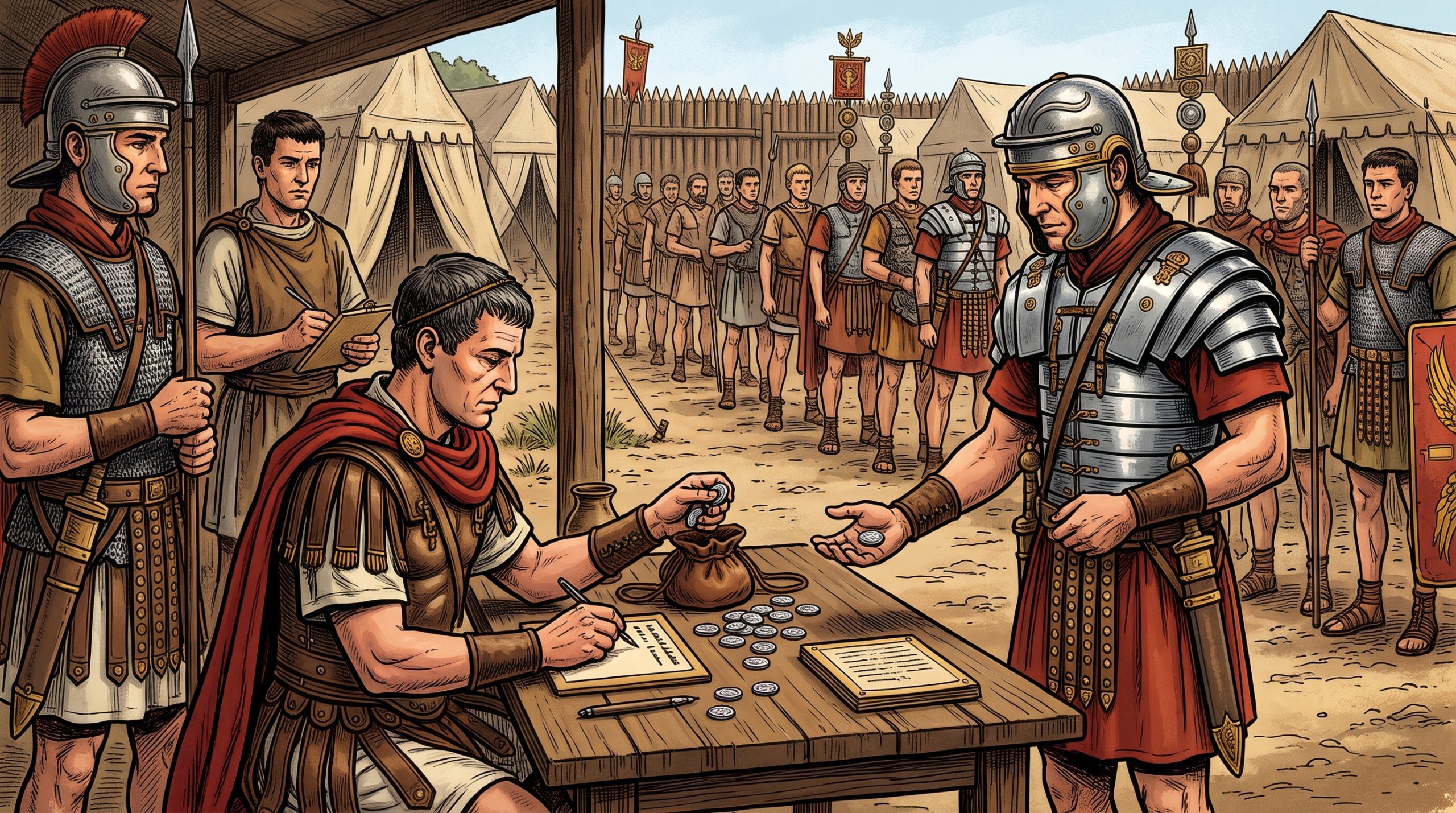
Few questions about ancient Rome sound simpler than how much did a Roman legionary get paid, yet the honest answer is surprisingly tangled. The short version is that a rank and file soldier under the first emperor earned 225 denarii a year, but that number hides deductions, bonuses, raises, and a few popular myths. Once you look closely at the stipendium, the picture changes from a plain salary into a fascinating story about power, loyalty, and money.
In this guide, we will walk through the numbers one layer at a time. You will see what the basic wage was, how emperors quietly changed it, what soldiers lost to food and equipment costs, and how a legionary compared with auxiliaries, centurions, and the elite guards of the capital. Along the way we will test the famous claim that soldiers were paid in salt, and we will ask what Roman army pay might look like in modern terms. Some of the answers are impressive, and some are genuinely painful.
Why Asking How Much Did a Roman Legionary Get Paid Matters
Money explains the Roman army better than battles do. Rome controlled a huge territory with a professional force that stayed loyal because it was paid reliably, and the state treated that reliability as a core part of its power. Soldiers who were fed, equipped, and paid regularly were far less likely to wander, rebel, or sell their swords to rivals. When people type “how much did a Roman legionary get paid” into a search box, they are really asking how an empire bought obedience from hundreds of thousands of men.
The state did not always carry that burden. In the early Republic, citizens served when threatened and supplied much of their own gear. Around 107 BC, the Republic took on the job of equipping and supplying its troops, which let poorer men enlist and turned soldiering into a career. That shift made regular wages the main attraction of service. Glory was a very pleasant extra, but a steady income was the real draw.
Polybius, writing in the middle of the second century BC, estimated a soldier’s pay at about two obols a day, which comes to roughly 120 denarii a year, with cavalrymen receiving around 180. Those early figures clearly show that the idea of a fixed wage was already well established long before the empire began.
The Basic Stipendium Under Augustus
Under Augustus, the annual stipendium of a legionary was set at 225 denarii. It was paid in three installments each year, and the first one traditionally came at the new year parade, when the troops renewed their oath to the emperor. That detail is easy to miss, but it matters: the payment and the promise of loyalty arrived together. Cavalrymen attached to a legion received more, with about 300 denarii a year.
To put the coins in context, 225 denarii equals 900 sesterces, which is the figure often quoted for the first century. New recruits were treated separately. They received 75 denarii in several installments to cover their travel costs to their assigned units, so a young man’s first payment was less a salary than a travel allowance.
Because the soldier signed up for about twenty years, the wage was not just a paycheck. It was the foundation of a whole career, and the promise of a discharge bonus at the end gave the job a long horizon that few ordinary workers could match.
How Domitian Changed Roman Army Pay
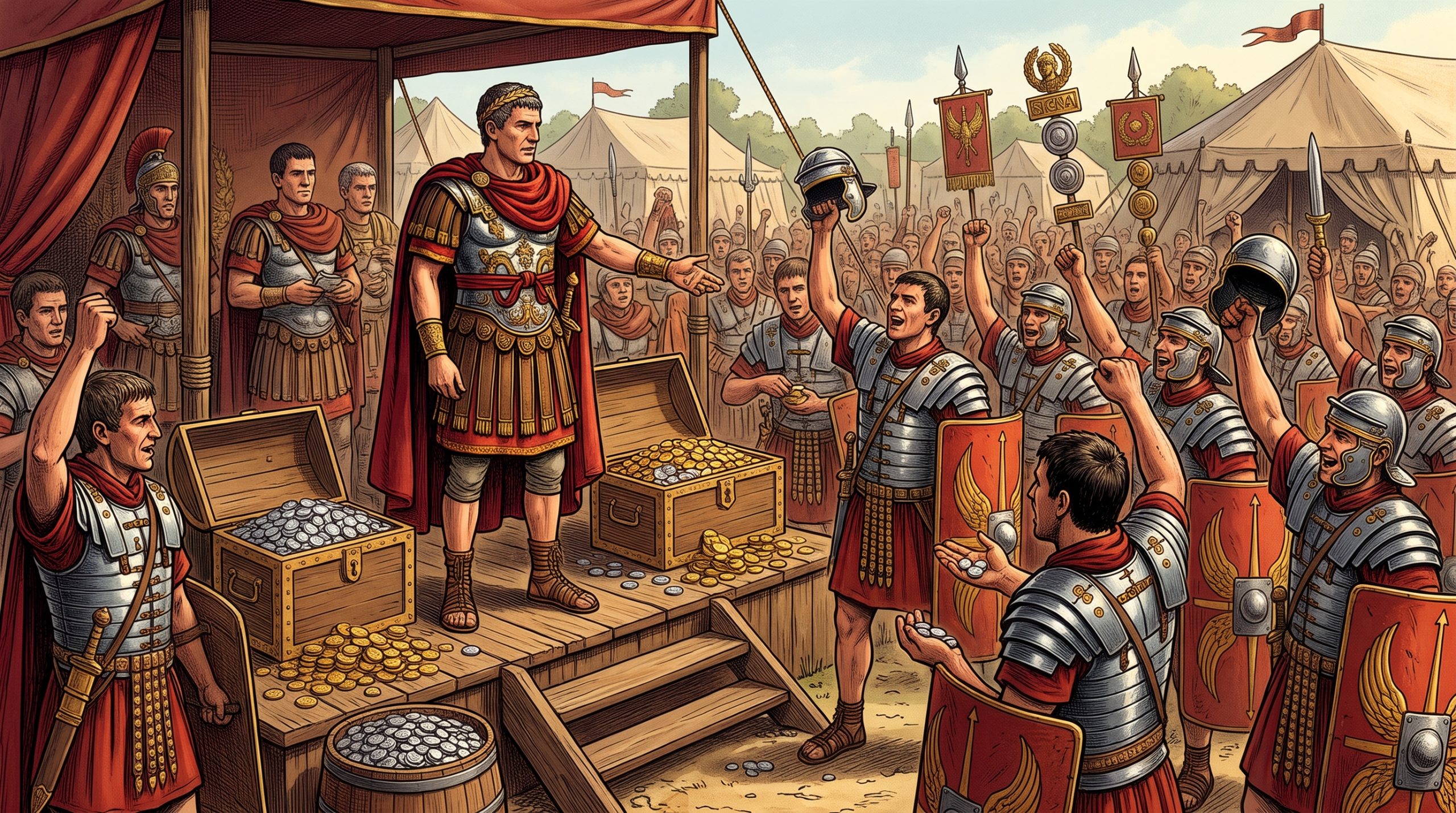
The legionary’s pay stayed the same until the reign of Domitian, who ruled from AD 81 to 96. He brought order to the financial administration of the state and awarded a raise that took the basic salary to 300 denarii a year. In practice, that meant a soldier who once collected 225 denarii now earned a third more.
Ancient sources describe the change in terms of gold coins, and scholars still debate the exact wording. The result is clear enough, though: the first century ended with a better paid army than it began with.
Later emperors added even more. By the fourth century, the old stipendium made up only 10 to 15 percent of a legionary’s total income, because bonuses and payments in kind had grown so large.
What Was Left After Deductions
Here is the part that surprises most readers. The salary was not all take home pay. A legionary’s basic pay was about 300 denarii a year in later sources, but out of it he had to pay for part of his food, equipment, and savings for a pension and funeral. What remained was paid to him every three months or so.
The British Museum gives a clear example from the first century: a salary of 900 sesterces a year shrank to less than 600 after deductions for rations, boots, and hay. That means a third of the wage or more never reached the soldier’s hand. For anyone imagining a Roman soldier swimming in silver, that is a shocking reality check.
Legionaries, Auxiliaries and Centurions Compared
Rome’s army had layers, and pay reflected them. The auxiliaries, who were usually not citizens, received roughly a third of a legionary’s wage. Estimates for an auxiliary infantryman run as low as 75 denarii a year in some accounts and around 100 in others, which shows how much the figures vary by source and period. They often handled the most dangerous work, which makes the gap feel even harsher.
A centurion lived in a different financial universe. The British Museum notes that an ordinary centurion earned fifteen times a legionary’s salary, so he could afford an enslaved person after setting aside only a few months of wages. At the top of the ladder, the chief centurion, called the primus pilus, earned about four times as much as an ordinary centurion, and when he retired he received a much larger severance.
That pyramid explains why ambition drove so many soldiers. A man who started in the ranks could, with luck and skill, climb into a life of real wealth.
The Praetorian Guard and the Cost of Living in Rome
Soldiers stationed in the capital were paid more, partly as an honor and partly to offset the expense of living in the city, much like the premiums paid in expensive capitals today. The night watch received 150 denarii, while infantry of the urban cohorts earned 375.
The Praetorian Guard did best of all. Its infantry collected 750 denarii a year, and its cavalry about 1,000. That was more than double a legionary’s wage after Domitian’s raise, and it came with proximity to the emperor. Claudius started the habit of rewarding the guard for helping him gain the throne, a precedent that turned a bodyguard into a political force.
The lesson here is that Roman army pay was never only about the work. It was also about who stood closest to power and how much that loyalty was worth.

Bonuses, Loot and the Donatives That Changed Everything
The base wage is only half the story. Emperors handed out donatives, which were special cash gifts, to keep troops happy. Caligula paid each legionary an extra 100 denarii after a campaign in the north. Augustus reportedly gave soldiers 2,500 denarii during a ceremonial return to Rome after a successful war. A single gift like that could exceed ten years of the basic wage.
At the end of service came the discharge bonus, known as the praemium. A soldier earned it after completing twenty years of regular duty, and it was meant to give him a secure start in civilian life.
Over time these extras grew so large that they dwarfed the salary. That is why the official wage alone never tells the whole story of Roman army pay.
The Myth of Salt Money
You may have heard that Roman soldiers were paid in salt and that this is where the word salary comes from. It is a popular story, and some retellings say the monthly allowance was called a salarium because the Latin word for salt is sal. The tale is charming, but it deserves caution. The well known descriptions of the wage speak of silver and gold coin, with deductions for food and gear, and payments in installments. The salt story is better treated as a legend than as a fact you can quote.
What Pay Looked Like in Today’s Money
Everyone eventually asks for a modern equivalent. The honest answer is that no conversion is perfect, because prices, wages, and daily life were so different. One estimate shared among Roman army enthusiasts suggested that in the first century a legionary earned about what a modern skilled craftsman does. Treat that as a rough comparison rather than a fact.
A better way to judge it is by purchasing power inside Rome. A legionary could save a meaningful amount over a twenty year career, he had few living costs, and his total income, including bonuses, could be impressive. At the same time, the deductions and the risks were real. He fought in dangerous places, marched with a heavy load of at least 90 pounds, and served far from home. The pay was good for the time, but nobody would call the life easy.
Conclusion: The Real Answer
So, how much did a Roman legionary get paid? Under Augustus the answer was 225 denarii a year, and after Domitian it rose to 300. After deductions the take home sum was smaller, while donatives, plunder, and a final discharge bonus could make the total far larger. Compared with auxiliaries, the legionary did well; compared with a centurion or the Praetorian Guard, he sat in the middle of the pyramid.
The better lesson is that Roman army pay was a system, not a number. It bought loyalty, rewarded ambition, and shaped the course of history. The next time someone asks how much did a Roman legionary get paid, you can give the full answer: it depended on the emperor, the year, the rank, and the bonuses.



Comments are for Silver members and up
Join the community to share your thoughts. Members keep the discussion friendly and spam-free.